
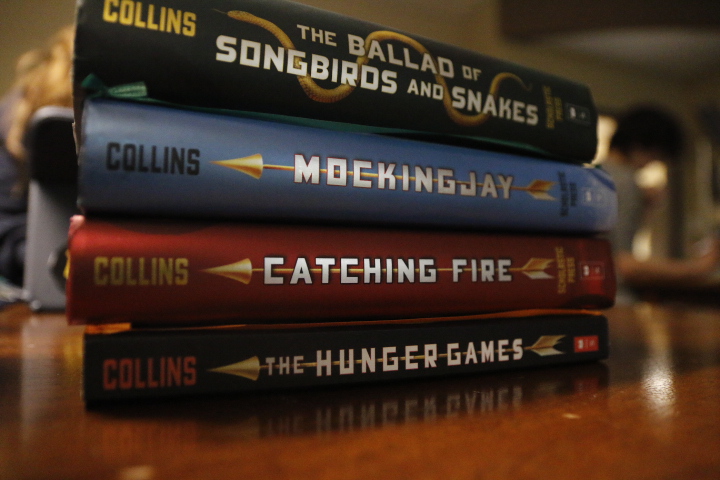
The Hunger Games is a book series many people have been immersed in for decades now. These books slowly enchant you as you fall in love with the complex storyline and compelling characters.The first three books gained such a following that the author Suzanne Collins decided to write two more books that were prequels to the award-winning series. All five books have now been adapted into movies, and the movie based on the most recent book, Sunrise on the Reaping, has the adaptation in theatres November 20th 2026.
In a place once known as North America, now known as Panem, is a very rich City surrounded by twelve Districts. Every year The Capitol likes to think they control all the Districts, there is something known as The Hunger Games! In the Hunger Games, two children, one boy and one girl from each district from the ages of twelve to eighteen, have to leave their families and compete in a live event that is aired on televisions all over Panem.
That is the basic premise for all of the books, and as the story evolves you become very connected to the characters. The prequels allow readers to see different aspects of older characters such as the President Coriolanus Snow and Haymitch who helps Katniss in the first book. The charm and feel of the books and characters stay the same throughout the series, which is why many long term fans remain deeply invested in the lore of the series.
Lyla Townsley, Freshman at Westminster Christian Academy, relates her thoughts about her favorite book in the series: “My favorite book in the Hunger Games series is probably the first one. It’s just a classic, and although I love the others, the first one just feels like it can’t be beat.”
Many hardcore fans are also very passionate about the movie adaptations! Starring Jennifer Laurence as Katniss Everdeen, and Josh Hutcherson as Peeta Mellark, the adaptations are seen as very accurate by critics and readers alike, which we all know is a very difficult feat.
A Hunger Games book review done by Tim Challies, a Reformed Baptist and Theologian, reveals that maybe The Hunger Games is more than just a good and evil trope teen fiction. Children who read the books are seeing pure evil doing battle with pure good and enjoying that contrast. It is so clear, so unconfusing, so real.
“I think there is more here, though, than mere good versus evil. I think there is a kind of evil here that does battle with the moral relativism in our culture. There is no doubt that these games are purely evil, that it is wrong to pit a child against another child in a battle to the death. Children who read the books are seeing pure evil doing battle with pure good and enjoying that contrast. It is so clear, so unconfusing, so real. The few, the rich, the residents of the Capital—their children are in no danger, so for them these bloody games are mere entertainment.”
The Hunger Games is not just a series that falls into the category of good and evil, with all the dramatics of secret requited love and dystopian reality. It is a book series that can be bonded over because there is a clear sense of the good and evil in Panem, and we enjoy stories with feminist eldest daughters and a compassionate family friend.
In my opinion, the movies are a worthy adaptation of the books. I remember sitting in my sun room in middle school on the edge of my seat in suspense, eagerly turning each page. My love for the movies is in a different place in my heart, I am infatuated with the way the actors portrayed the characters. My critiques are only of the third book in the series: Mockingjay. I find the middle of the book extremely repetitive and it doesn’t get to the point very well. Finally I would recommend this book to all and this story is amazing.