
Every Winter, the arena transforms into a battleground where freshmen dreams meet senior dominance, and two events stand above the rest as the truest tests of class unity. The rope may burn and bruised shins may appear, but for Westminster students and alumni, the memories of these battles remain as vivid as the day they fought for the Spirit Week Trophy.
Spirit Week has evolved over the decades, adding new and innovative games and events and building off of the early hits, but Tug-Of-War and Chariot Race endure as the games that define what it means to be a Wildcat. These are the competitions where juniors and seniors remind underclassmen of the natural order, where strategy meets determination, and where an entire class becomes something greater than the infamous trophy by the week’s end.
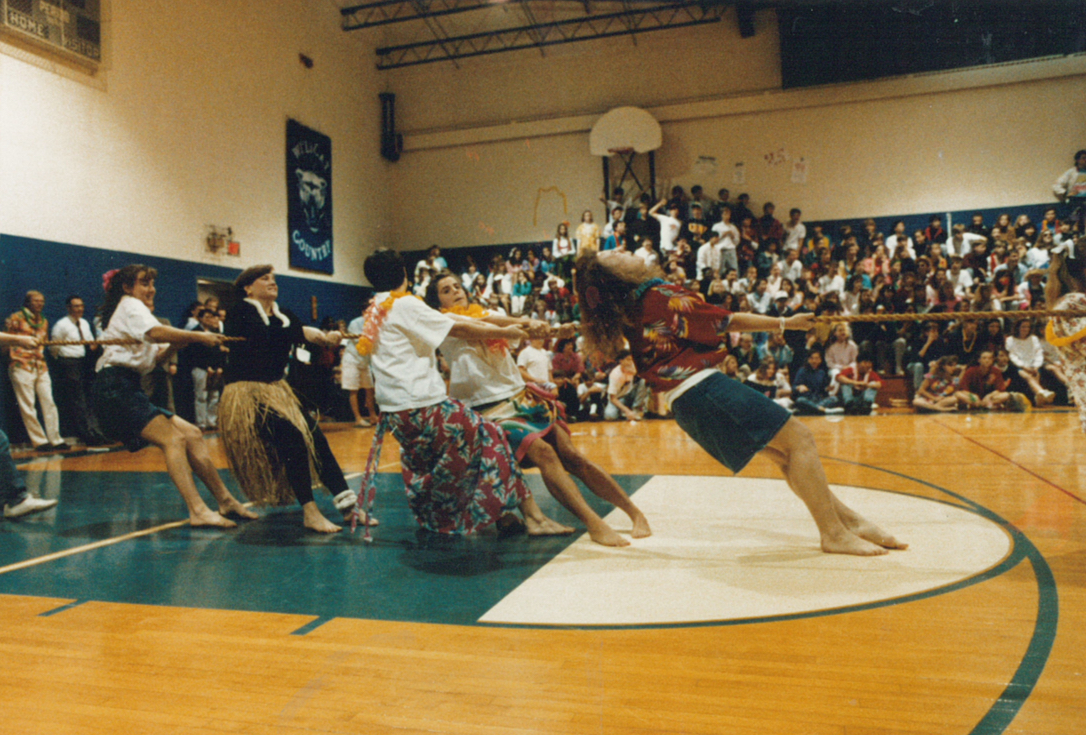
Tug-Of-War appears deceptively simple. Two classes grip opposite ends of a thick rope, plant their feet, and pull until one side crosses the line. Yet that simplicity masks the endurance and conviction invested in every inch of movement. Classes strategize about weight distribution and anchor positions. Sometimes the matchups end in utter domination, and sometimes it is a several minute bout until the other gives out.
“I just remember Tug-Of-War was one of the games that everyone cared about and which class won tug-of-war,” recalls Mrs. Collison, Westminster’s 11th and 12th grade counselor and class of 1997 Alumni. “It was always the one that was the most competitive.”
Westminster students watching understand this intensity. While every game and event gathers loud cheers and outbursts, Tug-Of-War transforms the arena into something like no other game can replicate. Students’ voices go hoarse, while they anxiously watch to see if their class can hold out. The arena gets the loudest often when there is an upset, such as the Freshmen over the Sophomores, or Sophomores over the Juniors. When a class finally drags their opponents across the line, the eruption of celebration roars off the walls.
“Well we did Tug-Of-War and Chariot Race for sure,” Mrs. Collison remembers, and if Tug-Of-War channels competitive spirit through strength, Chariot Race demands speed and endurance. One student sits atop a blanket or sack while their partner grips the edge and pulls them down the court, around a cone or teacher, and back to tag the next pair. Each duo must complete the circuit before the next can begin, and the class that finishes all their pairs first claims victory.
The beauty of Chariot Race lies in its unsuspecting difficulty. What looks straightforward becomes a test of stamina as the pullers, often larger and stronger than the one in the sack, feel their arms burn and riders, often small and agile, try to balance without tipping off. Unlike individual competitions, this relay-style event means every pair matters equally, as one struggling duo or a blanket gone haywire can make the difference between getting first and last. It is a microcosm of what Spirit Week represents: individual effort compounding into collective triumph or defeat.
Dan Burke, the upper school principal, remembers the game fondly from his own Spirit Week days. “I recall us rolling around on carts,” he says, the memory bringing a smile decades later. For alumni like Burke and Collison, these weren’t just games, but rather defining moments of their Westminster experience.
Spirit Week will continue evolving, and new traditions will emerge. However, when that oh-so-special week arrives and Westminster gathers for its annual competition, some truths remain constant: some ropes are meant to be pulled together, and some chariots are meant to be raced as one. Perhaps what makes certain games classics is not just the competition itself, but the way they crystallize a moment. The sweaty hands gripping a rope, voices going hoarse, the shared exhaustion of pulling a teammate across gymnasium floors. These are the games we return to, the ones that etch themselves into memory. What is it about these particular battles that makes them worth fighting year after year? Maybe it’s something one can only understand when they are there, leaning back with everything they have, feeling the weight of their entire class behind them.