
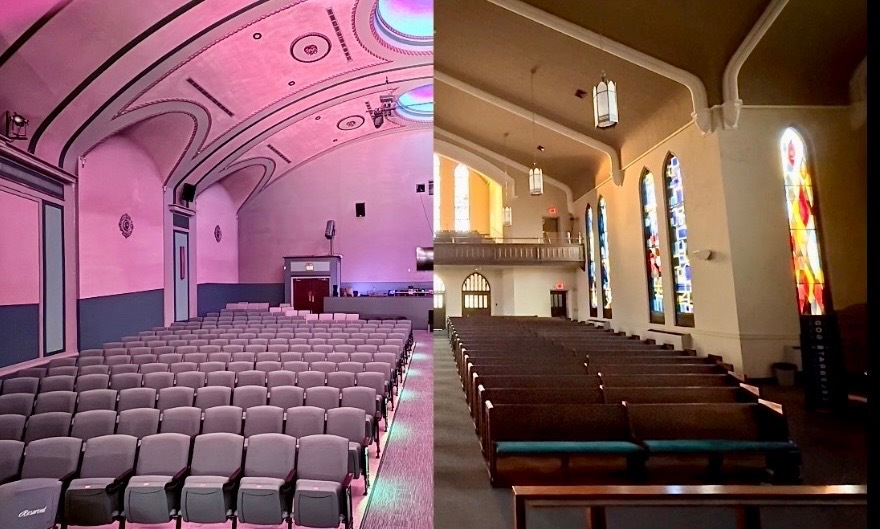
One of the beauties of attending Westminster Christian Academy is its robust and radiant Christian community. A plethora of vastly different viewpoints is represented, and this diversity comes with its benefits and its drawbacks. For instance, animosity and judgement often arises between Christians with differing beliefs, both viewing the other as uneducated, conforming, and even anti-Christian, but that tension can bring about open mindedness
Everyone has a reason for believing what they do, whether that be conviction, custom, or a combination of both. However, as necessary as it is to participate in your own church’s customs and understand your own church’s values, it is equally as important to pursue unity with other denominations you might not be as accustomed to and get a familiarity for the way they express their love for Christ.
Summing up Baptist thinking in a sentence, Westminster 12th grader Luke Mason of Concord Southern Baptist Church states:
“The philosophy of Baptists is that scripture is paramount and that tradition is not necessarily all that important.”
One motif that the Baptist church believes strongly in is Sola Scriptura, the idea that Christian faith should be centered around and filtered through Scripture and only Scripture. The Bible is the format for how we as Christians should live our life for Christ, and Mason strives to adhere to it because, as he says, “it’s the only thing that we know is true.” Consequently, the Southern Baptists reject all superfluous customs and rules, as they are not explicitly instructed in God’s word and are therefore unnecessary and even potentially distracting from the Church’s true purpose.
By stark contrast, the Catholic Church interprets the Bible in a different manner, incorporating many traditional practices unique to their denomination. They are not Sola Scriptura, meaning they partake in many practices that would likely seem nonsensical to a Baptist, but are personally significant and help them grow in their faith. WCA 12th grader Ginger Cox of Ascension Catholic Church speaks on the sacrament of communion in a Catholic mass, called the Eucharist. She believes that the bread and wine taken during this time is the actual body and blood of Jesus Christ.
“I am literally sitting in the room with Jesus during mass, and I just think that’s beautiful, and the feeling is unmatched. […] That first time was just the most beautiful feeling ever, and I think that my faith has really gone leaps ahead.”
When it comes to worship, the style and expression vary greatly between denominations. Presbyterians err on the side of reservation and serenity, while non-denominationals tend to have a more expressive approach. Aria Johnson, member of Covenant Presbyterian Church and junior at WCA says:
“Song-wise, we are a little bit more traditional; we have an organ in our church, but recently we’ve been doing a combo of […] more modern songs and then a lot of typical hymns.”
On the opposite side of the spectrum is a denomination that values personal connection over general comfort. Speaking on behalf of Refresh Non-Denominational Church, junior Evie Bubenik lays out the grand variety of ways that her church worships and why they choose that approach.
“We really do all different sorts. We take from black churches, white churches, we sing in Spanish sometimes. We do all different kinds just because we want to be inclusive. Also, we don’t just do music; we do praise dancing, there was a play last week, there’s poetry.”
Above all, it is crucial that Christians treat each other with respect and not let our various cultural specificities take precedence over our unified faith. This sentiment of a need for inter-denominational respect was shared by every interviewee. Aria Johnson, junior, commented on the importance of this sentiment:
“Ultimately, we all believe that Jesus Christ is Lord. He is our savior, and nothing can separate us from that. […] When we’re in a world that’s so anti-religious, we need to stick together and continue to shine a light in God’s world like he calls us to do.”
Spreading the gospel was essential for Jesus’s apostles and is still highly esteemed in many churches today, particularly in the Baptist community.
Speaking on behalf of Concord Southern Baptist church, senior Luke Mason explains:
“All Baptist churches are very evangelical, going out on mission, going around the world as the Lord has proclaimed, spreading his Word and his Gospel.”
In a society with a continually growing dependence on science and reason to explain the natural world, Christians in the 21st century are often forced to face the stigma and scrutiny directed at religion in their communities. However, in order to resist outward judgement, Christians must understand one another and work to remain “united in the same mind and the same judgment,” as instructed by Paul in Corinthians 1.